
Summary
- XR treadmills aim to restore leg-driven locomotion in XR while keeping the user physically in place.
- Two main designs dominate: passive low-friction sliding platforms and active motorized omnidirectional floors.
- Realism depends on a tight sensing-to-control loop, plus software mapping that manages turning, acceleration, and latency.
- They can reduce some discomfort versus joystick movement, but cannot fully eliminate cybersickness and often alter gait mechanics.
- Strongest fits today are supervised training, simulation, rehab research, and controlled production workflows, where safety and repeatability matter.
Extended reality (XR) has an oddly specific enemy: your walls.
Inside a headset, you can be in a factory the size of an airport, a ship, a museum, a battlefield, or a maze. In your living room or lab, you have maybe a few square meters before you collide with a chair and learn something about gravity. That mismatch forces most XR experiences to fake movement using thumbsticks, teleportation, or “walk in place” tricks. Those work, but they often feel less embodied and can trigger discomfort because your eyes say “moving” while your inner ear says “nope.”
An XR treadmill is one of the most literal attempts to close that gap: let your legs do what they evolved to do, while the hardware prevents you from actually traveling across the room.
Explained in seconds
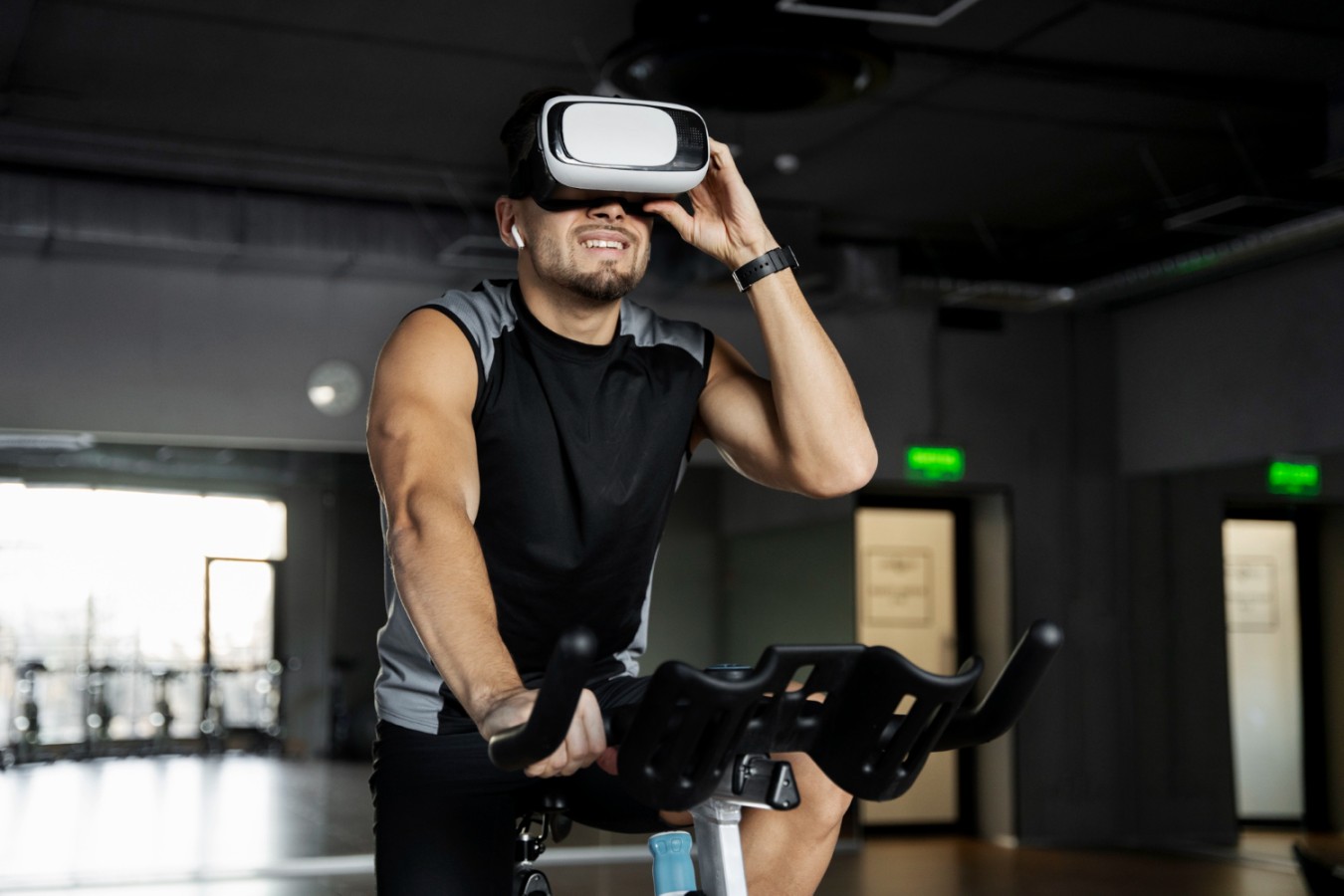
An XR treadmill is a locomotion device that lets you walk or run in a headset while staying roughly in the same physical spot.
You wear a headset (usually virtual reality, VR), step on a special platform, and often use a safety harness. The treadmill senses your steps and converts them into movement in the virtual world. Depending on the design, it either:
- makes your feet slide on a low-friction surface while sensors detect your gait, or
- actively moves the floor under you (like a robotic conveyor) to keep you centered.
Done well, it makes “walking” in VR feel more natural than a joystick, and can reduce some of the sensory mismatch that contributes to cybersickness.
What problem XR treadmills are actually solving
There are three overlapping problems.
First is space. Real walking is the gold standard for presence, but most tracking spaces are small. Redirected walking (RDW) is a software technique that subtly bends your path so you unknowingly walk in circles while thinking you are going straight. It helps, but it is constrained by perception thresholds and room geometry.
Second is comfort. Artificial locomotion (thumbstick motion, flying, smooth camera acceleration) can produce cybersickness through visual vestibular mismatch and other factors. Reviews consistently point to sensory conflict as a major mechanism, even if individual susceptibility varies.
Third is training fidelity. If you are doing safety training, rehab, ergonomics, or any task where gait and balance matter, “press forward on a joystick” is not a great proxy for “walk there, turn, stop, crouch.” Treadmills are attractive because they bring back some body-ground truth, even if imperfect.
Two main treadmill families
Passive low-friction platforms (sliding gait)
These devices typically use a concave or flat low-friction surface, special footwear or overshoes, and a harness ring. You “walk” by sliding your feet while your upper body is supported. Step detection comes from shoe sensors, optical tracking, or external trackers.
Examples in the market include Virtuix Omni One and KAT Walk style systems.
Why this design exists: it is mechanically simpler than a fully motorized omnidirectional belt, and it keeps the user in a predictable safety envelope.
The tradeoff: sliding is not the same as walking. Your foot does not roll heel-to-toe normally, traction is different, and turning can feel constrained.
Active motorized omnidirectional treadmills (robot floor)
These devices actively move the floor under the user to cancel out your motion and keep you near the center. Conceptually, the treadmill runs the negative of your velocity vector.
Infinadeck is a well-known example of a “true 360-degree moving floor” approach, described as adapting to user speed and direction in real time, using closed-loop sensing with encoders as part of its control system.
Why this design exists: if the floor can move under you, you can preserve more natural gait mechanics than sliding platforms, at least in principle.
The tradeoff: it is a hard robotics problem. You need fast sensing, low latency control, high reliability, and strong safety engineering. Any instability is a literal fall hazard.
The control loop, in plain engineering terms
Regardless of the mechanics, an XR treadmill lives or dies by a feedback loop:
- Sense intent
- Detect step timing, stride length, and direction.
- Some systems embed sensors in footwear and rely on platform sensing. KAT, for instance, documents dedicated shoes and setup procedures as part of its system design.
- Estimate the user’s velocity vector
- Translate raw signals into “user wants to move forward-left at X meters per second.”
- Apply a mapping into the virtual world
- Move the avatar/camera accordingly.
- Optionally apply gains (slightly scaling speed or curvature) to manage comfort and keep motion believable.
- Keep the body safe and centered
- Passive systems do this mechanically with a harness and limited platform.
- Active systems do it by moving the floor under you in milliseconds-scale loops, typically with closed-loop feedback from encoders and motor control.
A useful mental model: an active treadmill is basically doing real-time human-in-the-loop velocity cancellation. Your body is the unpredictable input signal.
Why treadmill walking still does not feel like “walking outside”
The surprising part for many first-time users is that “using your legs” does not guarantee natural gait.
Research comparing overground walking vs treadmill-like VR locomotion shows differences in kinematics and spatiotemporal parameters. Studies report slower speeds, shorter steps, and altered patterns on multidirectional or omnidirectional treadmill setups.
This is not just “new users being clumsy.” It is physics and perception:
- Friction and foot mechanics change. Sliding platforms reduce traction by design, which changes muscle activation and balance strategy.
- Turning is cognitively expensive in VR. Your visual scene rotates, your body rotates, and your treadmill constraints can add another layer.
- The harness alters posture. Supporting body weight and preventing falls changes how people move, even subtly.
- Optic flow and acceleration can shift gait. If the visual motion does not match what your legs and vestibular system expect, people self-limit speed.
For serious applications like rehab or gait assessment, researchers treat the treadmill-plus-VR system as its own locomotion condition, not a drop-in replacement for natural walking.
Cybersickness: what treadmills help, and what they cannot fix
Cybersickness is multi-factor, but sensory mismatch is a big recurring theme: your eyes report motion while vestibular cues do not match, and the brain reacts badly in a subset of people.
Treadmills can help because:
- your legs generate motor commands consistent with motion,
- your proprioception (body position sense) is engaged,
- your head motion during walking is more natural than thumbstick glide.
But treadmills do not automatically eliminate cybersickness because:
- you are still not translating through space the way your vestibular system expects, especially in passive sliding designs,
- visual acceleration, latency, and artificial turning can still create conflict,
- the treadmill may introduce its own weirdness (micro-slips, harness constraints, unnatural foot mechanics).
In practice, treadmills often shift the problem from “camera glide nausea” to “biomechanics plus turning plus calibration.” Better, sometimes. Not magic.
Integration reality: content decides whether the hardware matters
A treadmill is not just hardware. It is a contract with software.
To feel right, an experience needs to:
- accept treadmill locomotion inputs cleanly,
- handle turning and strafing without fighting the user,
- tune speed and acceleration curves conservatively,
- provide comfortable stop/start behavior,
- avoid latency spikes.
This is why some treadmill vendors ship more controlled ecosystems or integration layers, and why “it works with everything” is rare in practice.
From a product perspective, this is the adoption bottleneck: even a great treadmill is frustrating if only a narrow slice of content supports it well.
Where XR treadmills make the most sense today
Training and simulation (enterprise, defense, safety)
If your goal is procedural training, navigation under stress, or spatial memory, a treadmill can justify itself because physical movement is part of the task. The harness and controlled footprint also help with repeatability and supervision.
Active systems are especially interesting here because they can preserve more natural stepping while keeping users in place.
Rehabilitation and gait research
Researchers use VR plus treadmill paradigms to introduce controlled cognitive and motor challenges, and to study gait adaptation. Omnidirectional treadmill plus VR setups can be a safe way to probe balance and turning, especially when paired with clinical protocols.
Fitness and consumer gaming (a narrower fit than it sounds)
Yes, treadmills can increase physical intensity compared to controller-based movement in some studies.
But consumer success depends on very practical frictions: space, noise, cost, sweat management, onboarding time, and whether the experience library is worth dedicating a chunk of your room to a single device.
Virtual production and volumetric capture (a niche that is growing)
Some treadmill concepts are being positioned for film and capture workflows, where you want controlled, repeatable walking motion while staying within a stage volume and keeping camera tracking stable. Cyberith, for example, describes a video production oriented treadmill integrated with Unreal Engine for virtual production use cases.
What the next generation will likely look like
The most promising direction is not “bigger treadmill,” it is hybrids.
Expect systems that mix:
- modest physical walking zones,
- redirected walking algorithms to stretch that zone,
- conservative treadmill assistance for centering and safety,
- better perceptual models for when you can apply motion gains without detection.
On the human factors side, the frontier is reducing the “I am learning a device” feeling. That means better footwear mechanics, lower latency, more natural turning, and software standards for locomotion input that work across engines and devices.
XR treadmills are not a gimmick. They are a serious attempt to reconcile human locomotion with limited physical space. The reason they are not everywhere yet is also simple: walking is one of the most complex things your body does automatically, and turning it into a product forces you to make the implicit explicit, in mechanics, control theory, and perception science.