
Summary
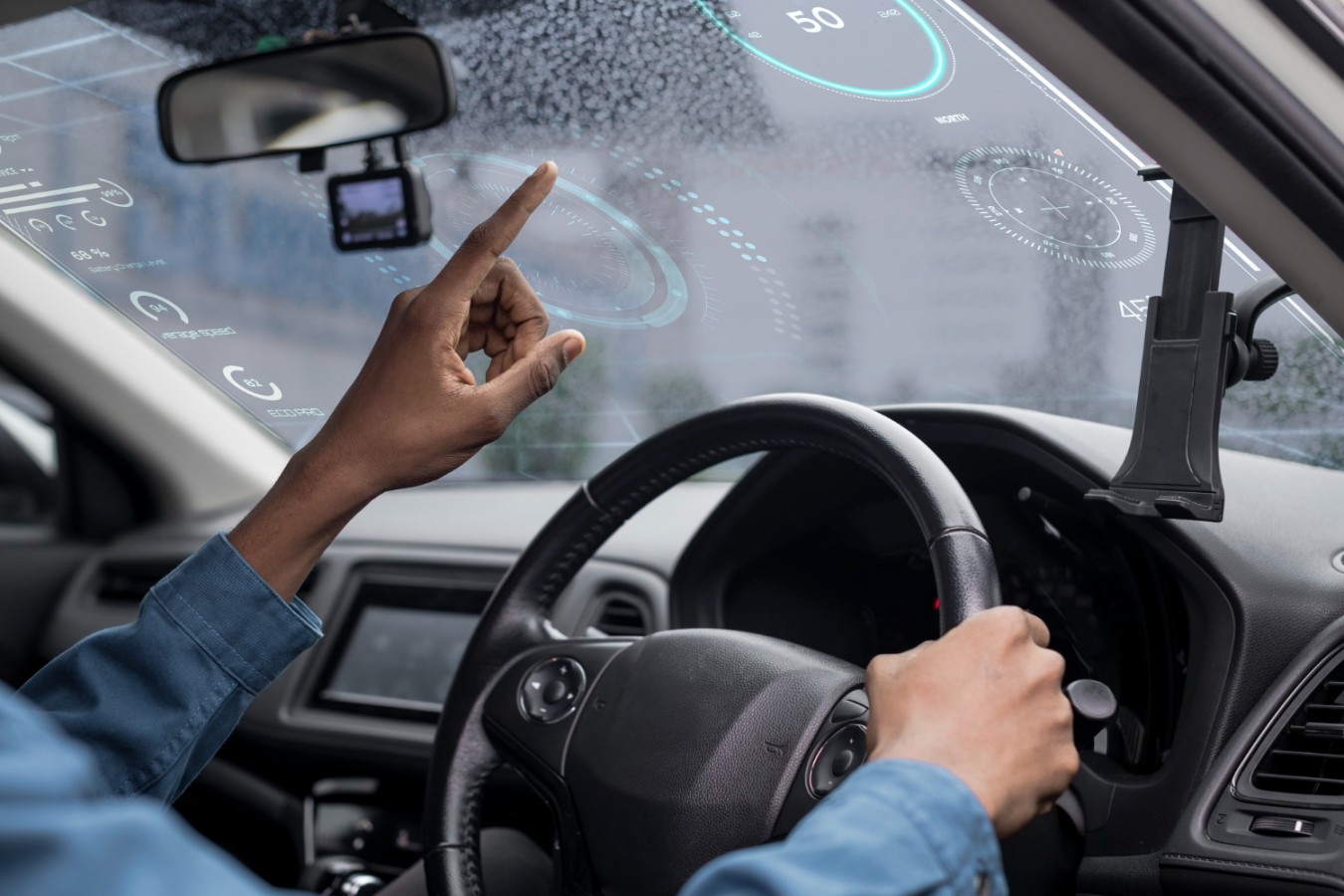
- A glasses-free AR windshield is typically an augmented reality head-up display (AR-HUD) that projects graphics into the driver’s forward view.
- The key optical goal is a stable virtual image at a realistic distance, plus enough eye box to work across driver positions.
- Windshield curvature and double-surface reflections create distortion and ghost images, often mitigated with wedge strategies and tight tolerances.
- Accurate “world-locked” overlays depend on system calibration across sensors, vehicle geometry, and HUD optics, not just rendering.
- Human factors and standards constrain what should be shown, prioritizing legibility and low distraction over dense AR visuals.
A windshield is already a display. It is a giant, curved, optically tricky sheet of glass sitting exactly where you want to put information: right in the driver’s line of sight.
The hard part is not “drawing pixels on glass.” The hard part is making those pixels behave like they belong in the real world, at the right apparent distance, in the right place, for drivers of different heights, in sunlight, over bumps, through polarised sunglasses, without ghost images, and without turning the road into a videogame UI.
“Glasses-free AR windshield” is the industry’s attempt to solve that with an augmented reality head-up display (AR-HUD): a projector and optics that use the windshield (or an embedded optical layer inside it) as a combiner, so virtual graphics appear out in front of the car rather than on a dashboard screen.
Explained in seconds
An AR windshield display projects symbols onto the windshield so they look like they are “floating” on the road ahead, like an arrow sitting on your lane or a highlight around a hazard.
It works by bouncing light off the windshield at just the right angles so your eyes perceive the image as far away, not on the glass.
Doing it well is difficult because the windshield is not an ideal mirror, drivers move their heads, and sunlight plus vibrations expose every optical flaw.
What “glasses-free AR windshield” really means
This is not the same thing as phone-based augmented reality (AR) or headset AR. In a car, “glasses-free AR” usually means:
- No wearable optics.
- A forward-looking view of the world remains direct, through the windshield.
- Virtual content is injected into that view using a head-up display (HUD) optical path.
There are two common HUD categories:
- Combiner HUD (also called teleprompter-style HUD): The virtual image appears close to the windshield surface.
- Augmented HUD (AR-HUD): The optics create a virtual image that appears meters in front of the driver, which is what makes “world-locked” overlays plausible.
When people say “AR windshield,” they almost always mean the second type.
The core optical trick: virtual image distance
Your eyes do not focus on “where a display physically is.” They focus on where the light rays seem to originate from.
An AR-HUD is designed so the rays entering your eyes look like they come from a plane roughly 7.5 to 15 meters ahead of the driver (numbers vary by design). That reduces the need for constant refocus between the road and the graphics, and it helps the overlay feel anchored in the outside scene.
A nice engineering detail here: resolution is often discussed in pixels per degree (ppd) rather than pixels per inch, because what matters is angular sharpness at that apparent distance.
The hardware blocks
Most AR-HUD architectures can be simplified into three subsystems:
- Picture generation unit (PGU): Makes the image: typically a microdisplay plus illumination (for example, digital micromirror device, liquid crystal on silicon, or similar projection engines).
- Relay and fold optics: Mirrors (often freeform surfaces) fold a long optical path into a constrained dashboard volume.
- Combiner element: The windshield (or a dedicated combiner) reflects the projected light into the driver’s eyes.
This sounds straightforward until you look at the packaging: large field of view (FOV) wants big optics and long path lengths, while car interiors want the opposite.
Why it is hard: the “physics tax” you always pay
Eye box and driver motion
The system must work not at one perfect eye position, but across a 3D volume where the driver’s eyes could be. That is the eye box.
A bigger eye box improves usability, but it makes optical design and brightness harder, because you are spreading the same light over more space.
Windshield curvature and distortion
Windshields are curved, laminated, and vary by model. That curvature acts like a weak lens and introduces distortion that you must pre-compensate.
If you change windshield supplier, thickness, or curvature tolerances, your calibrated optical model can drift.
Ghost images from double reflections
A windshield has inner and outer surfaces. Light can reflect from both, producing a faint second “ghost” image offset from the main one.
Ghosting is not just annoying. In a driving context it can increase visual effort and reduce legibility. Researchers analyze how wedge angles and thickness interact with perceived ghosting.
The classic mitigation is a wedge-shaped interlayer or wedge geometry that makes the two reflections overlap, reducing apparent doubling. Measuring and controlling wedge angle becomes part of the manufacturing and metrology story, not just optics design.
Sunlight, thermal load, and polarised sunglasses
Automotive optics must survive solar load and maintain image visibility in bright conditions. Some projection approaches also need to ensure the HUD remains visible through polarised sunglasses, which can otherwise dim reflected light.
Registration is a systems problem, not a rendering problem
To place an arrow “on the lane,” you need accurate alignment between:
- The vehicle coordinate frame
- The world model (maps, lane geometry)
- The sensor frame (camera, radar, lidar if present)
- The HUD optical frame (how pixels map to rays)
- The driver viewpoint (eye position)
Even small angular errors become noticeable far down the road. That is why AR-HUD is as much calibration, sensor fusion, and timing as it is projection.
Two main approaches: big free-space optics vs waveguides and holography
Approach A: Free-space mirror optics (today’s mainstream)
Most commercial HUDs use folded mirrors and a conventional combiner reflection off the windshield. These systems are mature and manufacturable, but large-FOV AR pushes them toward bulky “optical suitcases” inside the dash.
Approach B: Waveguides and holographic optical elements (to shrink size, enable larger images)
To reduce size while keeping a wide FOV and usable eye box, researchers and suppliers use holographic optical elements (HOEs) and waveguide combiners.
A waveguide HUD can couple light into a thin transparent plate, guide it via total internal reflection, then “extract” it toward the eye across a wider region (pupil expansion). A well-cited demonstration uses holographic elements for 2D pupil expansion and longitudinal magnification, essentially doing packaging magic with diffractive optics.
Continental has publicly described waveguide-based AR-HUD concepts targeting large augmentation areas at long projection distances (for example, around 10 meters) as part of tackling the size problem.
Holography is also showing up in recent HUD research as a route to compact, efficient systems and even multi-plane imagery (more on that next).
Depth cues: why “multi-plane” matters
A subtle limitation of many HUDs is that everything is drawn at one apparent distance. Real scenes have depth.
If you highlight an object that is 60 meters away but render the highlight at a fixed 8 meters, the brain can tolerate it, but the mismatch can reduce the “it belongs there” feeling and can increase visual effort for some content types.
Research prototypes explore multi-plane or varifocal HUDs, where imagery can appear at more than one virtual distance, or sweep between distances.
This is a promising direction, but it increases optical and calibration complexity quickly.
Human factors: legibility and distraction are first-class requirements
Even if you can draw perfect graphics, you still have to decide what should be shown.
Standards like ISO 15008 define minimum requirements and test procedures for in-vehicle visual presentation, focusing on legibility and image quality for dynamic information.
Regulators and industry groups also explicitly tie display design to driver distraction considerations, often referencing ISO-based requirements.
Practically, this pushes AR windshield design toward a few principles:
- Show less than you think you need.
- Prefer “glanceable” cues (simple shapes, stable placement).
- Avoid large animated elements that compete with the outside scene.
- Treat occlusion carefully. A highlight should not hide a pedestrian.
What typically ships first, because it survives contact with reality
If you look across current deployments and prototypes, the most robust “first wave” AR windshield features tend to be:
- Navigation guidance that aligns with the lane or turn
- Forward collision or hazard highlighting
- Adaptive cruise and lane-keeping status cues placed near the road center
- Speed limit and sign-related prompts when confidence is high
Anything that depends on fragile perception, like “boxing every object,” tends to get scaled back or gated behind high-confidence conditions, because a wrong overlay is worse than no overlay.
Where this is going
The direction of travel is clear:
- Smaller optical packages via waveguides and holography.
- Better depth handling via multi-plane and varifocal approaches.
- Tighter integration with perception stacks, but with stricter confidence gating, because AR makes errors visually loud.
The windshield will keep becoming “smart glass,” but the winning systems will be the boring ones in the best sense: legible, stable, calibrated, and humble about uncertainty.
That is what makes a glasses-free AR windshield worth building.